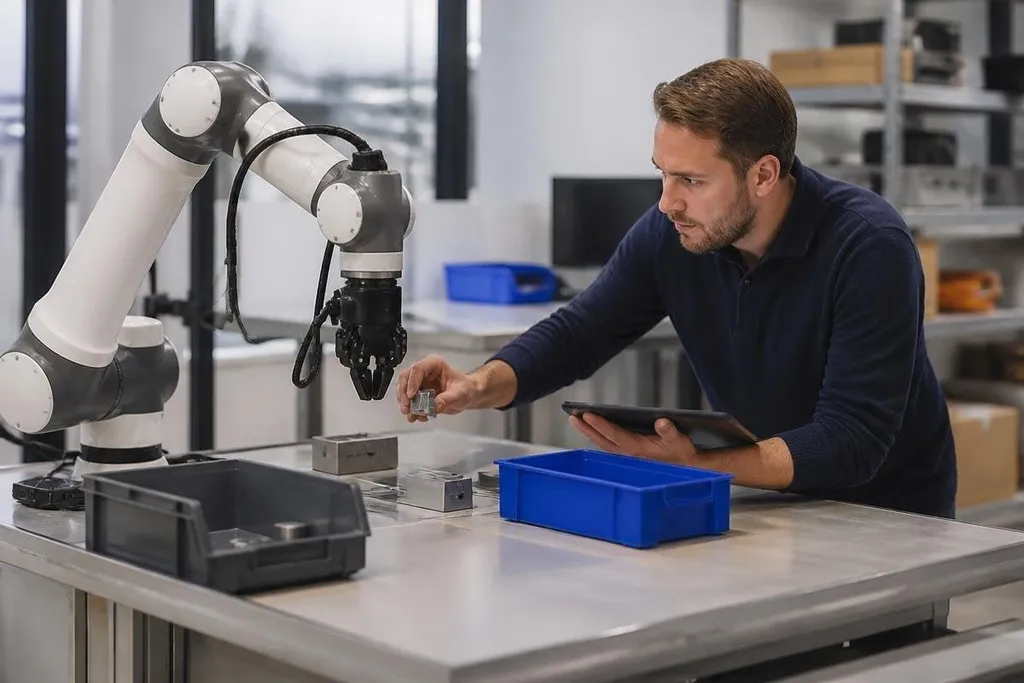
A robot can have motors, cameras, and software, yet still fail at the job it was bought to do. The business opportunity sits in the work between a factory-ready machine and a machine that can handle a real task safely.
- Training turns a general robot into a task-specific tool.
- Simulation cuts some testing before hardware reaches the work area.
- Service teams can earn revenue after the first robot ships.
What robot training includes
Training a robot means giving it the data, rules, and practice needed for a defined task. That may involve collecting images, labeling objects, recording human demonstrations, tuning motion, or setting limits around people and equipment.
The work changes with the robot. A warehouse arm may need to learn where boxes sit and how much force a gripper can use. A mobile robot may need maps, route rules, and a way to react when a pallet blocks its path. A training company can sell this work as a project, a software service, or a long-term support contract.
The task definition matters. “Pick products” is too broad to price or test well. A usable brief names the object, the pickup point, the handoff point, the allowed speed, and the failure response. That detail gives the customer a way to judge the result.
Where the business work appears
The first opening is data work. Robots need examples that match the place where they will run, so a company may collect sensor recordings, label images, or record teleoperation sessions. The value comes from making the data fit one task and one robot, rather than selling a large pile of unrelated files.
Simulation is another service. A team can test routes, reach, collisions, and grasping in software before running the same task on hardware.
Simulation won't remove floor testing, because real lighting, surfaces, loads, and people still affect the result. It can reduce the number of early hardware trials when the virtual model matches the physical setup closely enough.
Integration creates a third line of work. Training must connect with cameras, grippers, fleet software, safety controls, and the customer's existing systems. Lab success does not finish the job if the robot cannot receive an order from the warehouse system.
Companies also need monitoring and retraining. A new box size, changed shelf layout, worn gripper, or software update can alter the robot's results. That creates recurring work: check performance, find the cause of failures, update the model or rules, then test the change before release.
Training work sits between the robot, its software, and the staff who keep results stable. Robot24.com business robotics reports can give you dated examples of these services before you price them.
How providers can charge
The pricing model should follow the work. A fixed project fee fits a narrow task with a clear site and acceptance test. A monthly service fits a fleet that needs data review, software updates, and support after deployment. A usage fee may fit a training system that runs repeated simulations or processes sensor data.
Customers will ask what counts as success. The contract should state the task, test conditions, safety limits, response time for faults, and who owns the trained model and collected data. It should also say what happens when the robot fails a test, because correction work can cost more than the first training run.
The largest risk is poor transfer from one site to another. A model trained around one shelf layout may need new data at a second site. A provider that prices every new location as if it were identical will either lose money or cut corners.
I’d start with one narrow task and a paid acceptance test, then add nearby tasks only after the first one works on the customer’s floor.
A practical decision guide
Before starting a robot-training service, check these points:
- Name the task: Write down the object, motion, handoff, and failure state.
- Set the test: Choose the load, surface, lighting, speed, and pass rate.
- Choose the asset: Decide who owns the data, model, software, and hardware changes.
- Price the aftercare: Include monitoring, retraining, fault review, and site changes.
- Limit the promise: State what the system has not been tested to do.
The next business opportunity will belong to teams that can connect training to a paid task and show the result under stated conditions. A robot sale starts the relationship; the training record, acceptance test, and support plan decide whether it continues.